TL;DR:
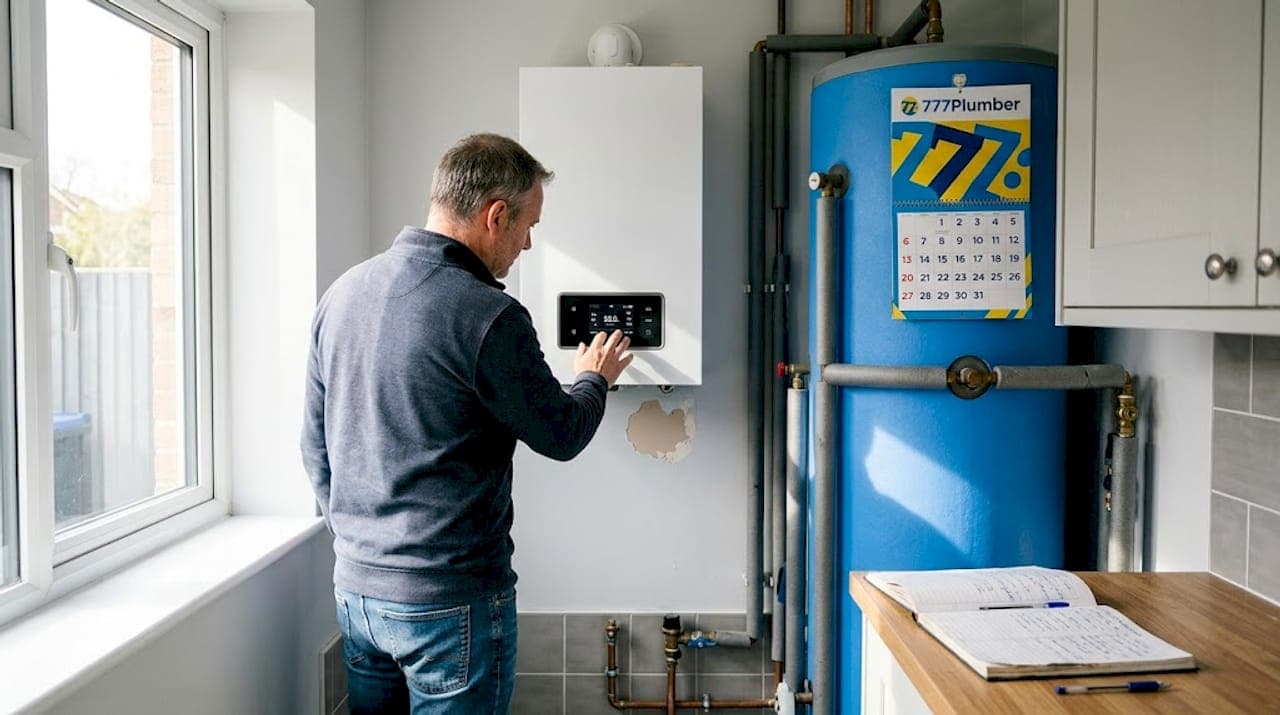
- A system boiler heats your home with a central unit and stores hot water in a cylinder, ideal for large households. It offers longer lifespan and simultaneous hot water supply without pressure drops, but requires more installation space and higher upfront costs. Regular servicing and proper sizing ensure reliable performance and extend its efficiency over 15 to 20 years.
If you're weighing up a new heating system and wondering what a system boiler actually is, you're not alone. Many homeowners assume it's just another name for a combi boiler. It isn't. A system boiler is a fundamentally different piece of kit, and understanding the distinction could save you thousands of pounds and a great deal of frustration down the line. This guide breaks down what system boilers are, how they work, how they compare to other boiler types, and whether one is the right fit for your home.
Table of Contents
- Key takeaways
- What is a system boiler?
- How a system boiler works
- System boiler vs combi and regular boilers
- Benefits and considerations of system boilers
- System boiler installation and upkeep
- My honest take on system boilers
- Need help with your system boiler?
- FAQ
Key takeaways
| Point | Details |
|---|---|
| System boilers store hot water | They work with a separate hot water cylinder, supplying multiple taps at once without pressure drops. |
| Best suited to larger homes | System boilers are ideal for properties with three or more bathrooms and high daily hot water demand. |
| Longer lifespan than combis | System boilers typically last 15 to 20 years, compared to 10 to 15 years for combi boilers. |
| Installation costs more upfront | Expect to pay between £1,800 and £2,800 for a full system boiler installation. |
| Annual servicing is non-negotiable | Book your boiler service in spring or summer, not winter, for better reliability when you need it most. |
What is a system boiler?
A system boiler is a central heating boiler that heats your home's radiators and stores hot water in a dedicated cylinder for later use. Unlike a combi boiler, which heats water on demand directly from the mains, a system boiler pre-heats and stores a large volume of hot water ready to be drawn on whenever you need it.
The key components that make up a system boiler setup are:
- The boiler unit itself. This burns gas (or another fuel) to heat water, which is then circulated through the central heating system and into the hot water cylinder.
- The hot water storage cylinder. Usually located in an airing cupboard, this insulated tank holds pre-heated water and keeps it ready for use across multiple outlets.
- The expansion vessel and pump. Built into the boiler unit, these components manage water pressure and circulation without the need for a separate feed and expansion tank in the loft.
- Heating controls. Thermostats, programmers, and zone controls allow you to manage when and where heat is delivered throughout the property.
One practical detail worth knowing: because the pump and expansion vessel are built into the boiler, system boilers are simpler to install than older regular (or "heat only") boilers, which require additional tanks in the loft. System boilers do, however, need more installation space due to the hot water cylinder and are best suited to homes with three or more bathrooms and high hot water demand.
System boilers also work well with underfloor heating. However, compatibility with underfloor heating may require pipework adjustments to match the lower water temperatures these systems typically operate at.
How a system boiler works
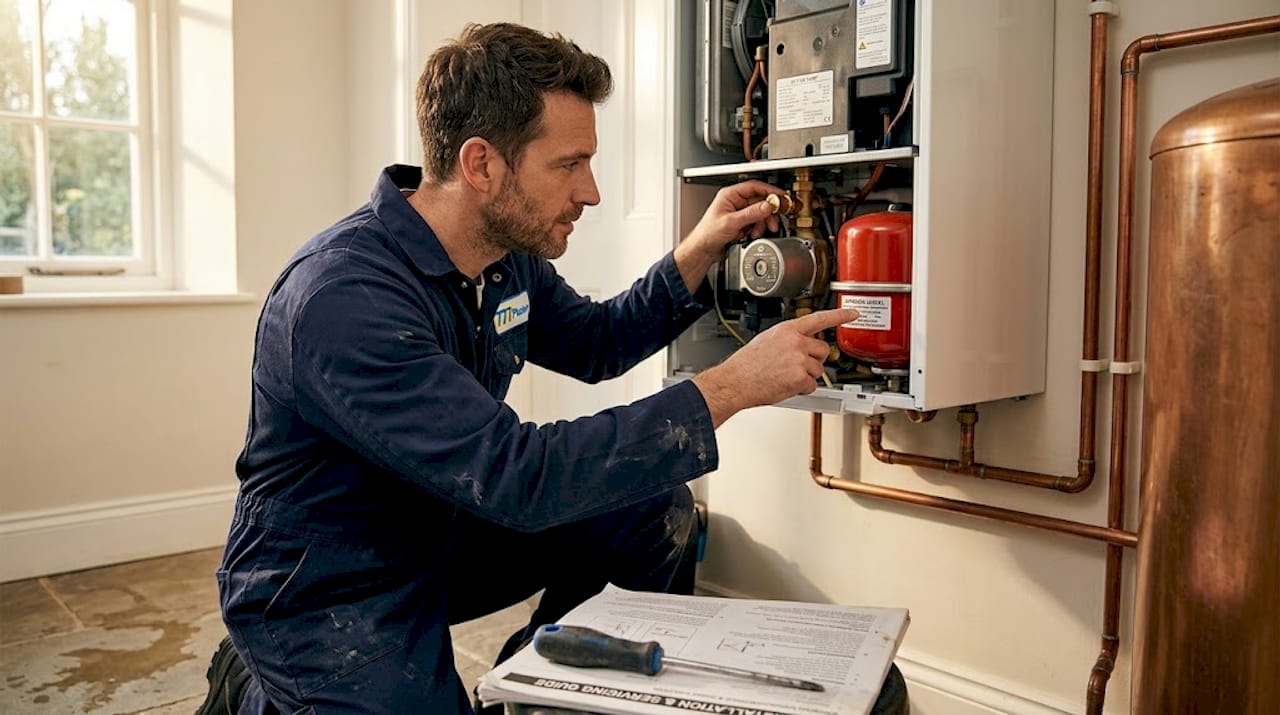
Understanding how a system boiler operates in practice makes it far easier to decide whether it suits your household's needs.
Here is the basic process, step by step:
- The boiler fires up. When your heating programmer or thermostat calls for heat, the boiler ignites and begins heating water from the mains supply.
- Water circulates through radiators. The pump pushes heated water around the central heating circuit, warming your radiators and keeping room temperatures at the level you've set.
- The hot water cylinder fills. Simultaneously, or at a set time you programme, the boiler heats water that is then stored in the hot water cylinder. This cylinder holds enough water to supply multiple bathrooms and kitchen taps at once.
- Hot water is available on demand. When you turn on a tap or run a bath, hot water is drawn directly from the cylinder. Because the water is already heated and stored, there's no wait time and no drop in pressure, even if two people are showering at the same time.
- The cylinder reheats as needed. Once the stored water drops below a set temperature, the boiler fires again to top it back up.
This is the core advantage a system boiler holds over a combi: system boilers supply multiple taps simultaneously without any reduction in flow rate. A combi boiler splits its heating capacity across however many outlets are open, which can mean a frustratingly weak shower if someone else is also running the hot water.
It's also worth noting the difference between stored and on-demand hot water. A combi boiler heats water only when you ask for it, which can mean a short delay and a finite flow rate. A system boiler gives you a ready reserve, but that reserve can run out if demand is very high, and then you'll wait for the cylinder to reheat. In most UK family homes, a correctly sized cylinder handles daily demand without issue.
Pro Tip: Spring or summer boiler servicing leads to fewer emergency breakdowns and better heating reliability in winter months. Book your annual service before September, not in January when engineers are at their busiest.
System boiler vs combi and regular boilers
This is where most homeowners need the clearest guidance, because the right boiler type depends entirely on your property and how you live in it.
How they compare at a glance
| Feature | System boiler | Combi boiler | Regular boiler |
|---|---|---|---|
| Hot water storage | Separate cylinder | None (on demand) | Separate cylinder and feed tank |
| Loft tank required | No | No | Yes |
| Suitable for large homes | Yes | No | Yes |
| Simultaneous hot water | Yes | Limited | Yes |
| Installation space needed | Moderate | Minimal | Most |
| Typical lifespan | 15 to 20 years | 10 to 15 years | 15 to 20 years |
| Approx. installation cost | £1,800 to £2,800 | £500 to £3,000 | £1,500 to £2,500 |
System boilers tend to last 15 to 20 years, noticeably longer than combi boilers which typically manage 10 to 15 years. That lifespan difference matters when you're calculating long-term value.
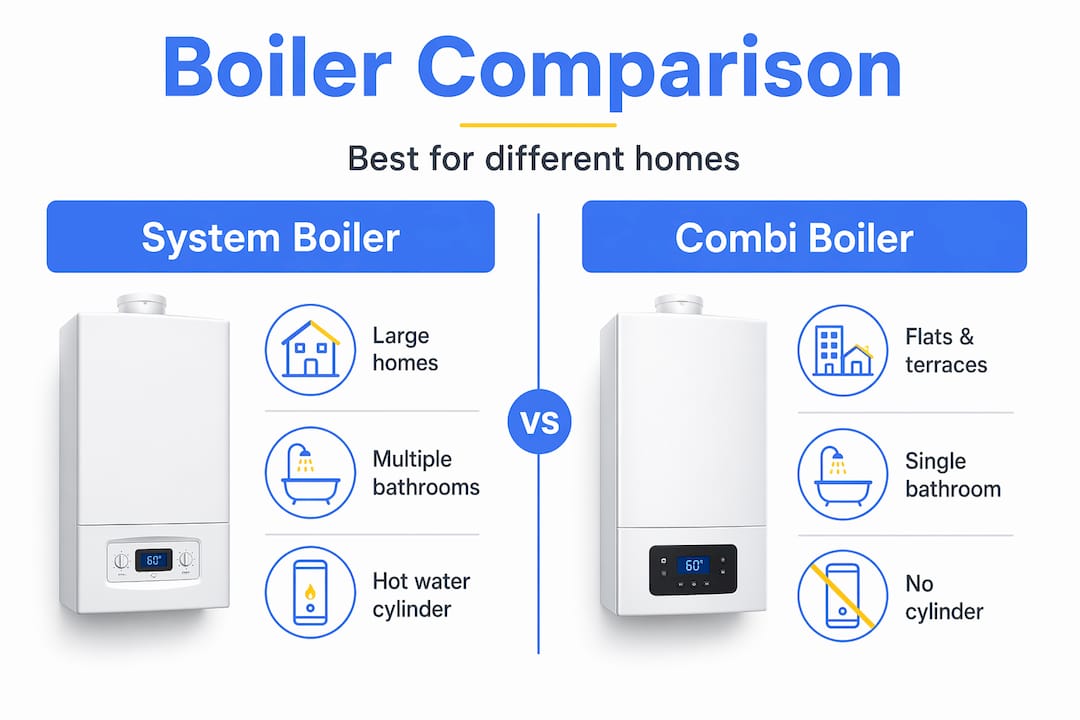
The combi boiler suits flats, small terraces, and one or two-bedroom properties where space is tight and hot water demand is low. It's compact, requires no cylinder, and heats water instantly. For a single person or a couple without a guest bathroom, a combi often makes perfect sense.
System boilers suit larger properties with higher occupancy. Consider a four-bedroom family home where two teenagers are showering before school while someone else runs the kitchen tap and the dishwasher is on. A combi boiler in that scenario would struggle noticeably. A system boiler, paired with a properly sized cylinder, handles it without complaint.
It's also worth mentioning storage combi boilers as a middle-ground option. These have internal cylinders of 30 to 60 litres, which improves flow rates under simultaneous demand while keeping the compact footprint of a standard combi. They're worth considering if you're upgrading a medium-sized property and don't want the space commitment of a full external cylinder.
Key factors to consider when choosing between the three types:
- Number of bathrooms. Two or more bathrooms generally calls for a system or regular boiler.
- Available space. A system boiler needs room for a cylinder, typically in an airing cupboard.
- Existing pipework. Replacing a regular boiler with a system boiler often reuses existing pipework, reducing labour costs.
- Hot water usage patterns. High, simultaneous demand favours stored hot water systems.
Benefits and considerations of system boilers
The benefits of system boilers are particularly clear for the right household. Getting the most from one depends on understanding what you're buying into.
The main advantages are:
- Simultaneous hot water to multiple outlets. No pressure drops, no cold surprises mid-shower.
- Reliability for larger households. System boilers are built to handle consistent, high-volume demand day after day.
- No loft tank required. Unlike regular boilers, all the key components are either in the boiler unit or the cylinder, keeping your loft clear.
- Compatibility with solar thermal panels. If you're considering renewable energy upgrades, many system boilers can be paired with solar water heating to pre-warm the cylinder, cutting energy bills further.
- Longer lifespan. As noted, 15 to 20 years is a reasonable expectation with proper maintenance.
On the cost side, installation typically runs from £1,800 to £2,800, which is higher than many combi installations due to the additional components and labour involved. You'll also need ongoing space for the cylinder, which some smaller homes simply cannot accommodate.
There is one practical drawback worth being honest about: if your cylinder runs out of hot water during a high-demand period, you'll wait 30 to 60 minutes for it to reheat. Proper sizing at the point of installation solves this in most cases. Fitting a cylinder that's too small for your household's usage is one of the most common and avoidable mistakes in system boiler installation. Proper sizing and fitting of the hot water cylinder is crucial for adequate water flow and avoiding pressure loss.
Pro Tip: Always ask your installer to size the hot water cylinder based on your household's peak daily usage, not just the number of bedrooms. A family of five with different morning routines needs a meaningfully larger cylinder than a family of five where everyone showers in the evening.
System boiler installation and upkeep
Getting a system boiler installed correctly is as important as choosing the right model. Here's what to expect and how to keep it running well for years.
Before installation:
- Get at least two or three quotes from Gas Safe registered engineers. Prices vary, and the cheapest quote isn't always the safest choice.
- Confirm the engineer will conduct a full system flush before fitting the new boiler. Old sludge in radiators dramatically shortens boiler lifespan.
- Discuss cylinder location, size, and any upgrades to controls or thermostats at the quoting stage, not after work has begun.
Ongoing maintenance matters more than most homeowners realise. Regular boiler servicing improves safety, prevents breakdowns, and keeps running costs down by catching wear early. An annual service should be non-negotiable regardless of boiler age.
Common issues to watch for with system boilers include:
- Low boiler pressure. Usually resolved by topping up via the filling loop, but recurring drops can indicate a leak or faulty pressure vessel.
- Cold spots on radiators. Often caused by sludge or air in the system. Bleeding radiators or a power flush usually sorts it.
- Cylinder not heating up. Check the immersion heater and thermostat settings. If the boiler is firing but the cylinder stays cold, the diverter valve may need replacing.
For a more detailed breakdown of common heating faults and fixes, the UK heating troubleshooting guide at 777plumber covers most scenarios homeowners face. Staying on top of heating maintenance in 2026 is particularly worthwhile given rising energy costs, where any efficiency loss directly hits your bills.
My honest take on system boilers
I've spoken with many homeowners who made their boiler decision based on upfront cost alone, fitting a combi in a large family home because it was cheaper on the day. Six months later they were back in touch, frustrated with low pressure and a queue for the shower. The system boiler that would have cost more to install would have paid for itself in convenience within a year.
What I find genuinely underappreciated is the lifespan advantage. A system boiler that's well maintained and correctly installed will often still be running reliably at 18 or 19 years old. That changes the maths considerably when you spread the installation cost over that timeframe.
My advice for any homeowner with three or more bedrooms, more than one bathroom, and a household that runs on a morning schedule: look closely at system boilers before you commit to anything else. The stored hot water model suits real family life in a way that on-demand heating simply doesn't. And if you're replacing a regular boiler, the switch to a system boiler is often simpler than people expect because the existing pipework layout is usually compatible.
The one thing I'd push back on is the idea that system boilers are inherently more complicated or risky to maintain. They're not. They're reliable, well-understood technology. Keep up with annual servicing, address small faults early, and a good system boiler will outlast most other appliances in your home.
— Michael
Need help with your system boiler?
Whether you're considering a new system boiler installation or your current one needs attention, 777plumber is ready to help. Our fully employed, Gas Safe registered engineers cover Bristol and the surrounding areas, with 24-hour local plumbing services available for urgent issues. We offer transparent, fixed pricing with no call-out charges and no fix, no fee on repairs.

From initial advice and quotes to full installation and annual servicing, our team handles the entire process in-house. No subcontractors. No surprise costs. If you want a straight answer on which boiler type suits your home, give us a call or book online today.
FAQ
What is a system boiler and how does it differ from a combi?
A system boiler heats water and stores it in a hot water cylinder for use across multiple outlets simultaneously. A combi boiler heats water on demand without a cylinder, which limits its performance in larger homes with high hot water demand.
How long does a system boiler last?
System boilers typically last 15 to 20 years with regular servicing, which is longer than the 10 to 15 year average for combi boilers.
What size home suits a system boiler best?
System boilers are best suited to properties with three or more bedrooms and two or more bathrooms, where multiple people regularly need hot water at the same time.
How much does system boiler installation cost?
System boiler installation typically costs between £1,800 and £2,800, depending on the complexity of the installation and the cylinder size required.
When should I service my system boiler?
Book your annual boiler service in spring or summer rather than winter. This reduces the risk of breakdown during the months when you rely on your heating most.