TL;DR:
- Regular annual boiler servicing ensures safety, efficiency, and warranty compliance for UK homeowners.
- Professional checks include inspections, cleaning, safety tests, and safety device verification.
- Proper maintenance lowers energy bills, reduces breakdown risk, and extends appliance lifespan.
Most homeowners only think about their heating system when something goes wrong. A cold morning, a boiler that won't fire up, and suddenly you're facing an emergency call-out and a repair bill that runs into hundreds of pounds. The reality is that annual boiler servicing by a Gas Safe registered engineer is one of the most cost-effective things you can do as a UK homeowner. This article walks you through what heating maintenance actually involves, why it matters far more than most people realise, and the legal and financial consequences of leaving it too late.
Table of Contents
- Why heating maintenance matters for UK homes
- What does heating maintenance include?
- The real benefits: Efficiency, cost savings, and reliability
- Legal, insurance, and warranty implications
- Our perspective: Why the unseen value of maintenance matters even more
- Get help with your heating maintenance
- Frequently asked questions
Key Takeaways
| Point | Details |
|---|---|
| Professional checks crucial | Annual servicing by Gas Safe engineers is essential for safe and efficient heating. |
| Maintenance saves money | Routine upkeep prevents costly breakdowns and keeps energy bills lower. |
| Legal and warranty compliance | Regular servicing is needed for insurance, warranties, and landlord legal obligations. |
| Expert help available | Local certified plumbers make maintenance simple and reliable for UK homeowners. |
Why heating maintenance matters for UK homes
Your heating system works harder than almost anything else in your home. Through autumn and winter, it runs daily, often for hours at a stretch. Without regular upkeep, components wear down, efficiency drops, and small faults become expensive problems. The troubling part is that the most dangerous issue, a carbon monoxide leak, has no colour and no smell. You won't know it's there until someone falls ill.
This is why heating maintenance isn't just about comfort. It's about safety. A neglected boiler can develop cracks in the heat exchanger, which allows carbon monoxide to seep into your living spaces. Regular professional servicing catches these faults before they become life-threatening.
"A boiler that hasn't been serviced in several years is not just inefficient — it's a potential hazard. Engineers consistently find corroded components, blocked flues, and gas pressure faults in poorly maintained systems."
Beyond safety, the financial case is clear. Skipping annual servicing to save £80 to £120 now can easily result in a repair bill of £300 to £800 later. Emergency call-outs alone often cost more than a full year's worth of scheduled maintenance.
Here's what neglecting your heating system typically leads to:
- Reduced efficiency, meaning your boiler burns more gas to produce the same heat
- Higher energy bills, sometimes 10 to 15% more than a well-maintained system
- Increased breakdown risk, particularly during cold spells when demand is highest
- Shortened appliance lifespan, reducing the typical 10 to 15-year life expectancy
- Voided warranties and insurance complications, which we'll cover in more detail later
It's also worth noting the legal dimension. Annual plumbing checks are a legal requirement for landlords under UK gas safety law, and the plumbing regulations guide makes clear that even homeowners have obligations tied to their warranties and insurance policies. Ignoring these requirements doesn't just put your system at risk — it can invalidate your cover entirely.
The bottom line: Regular maintenance is the single most reliable way to keep your heating system safe, efficient, and compliant.
What does heating maintenance include?
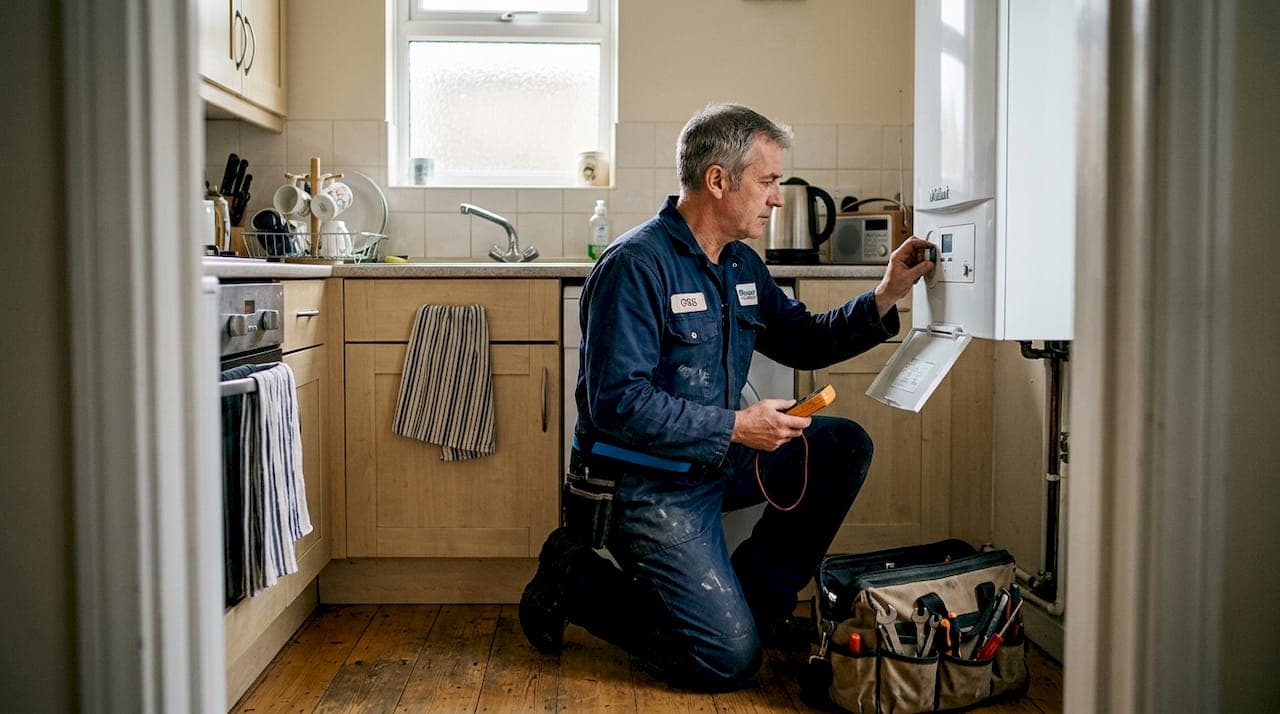
Many homeowners assume a boiler service is simply someone coming to take a quick look and sign a form. In reality, a thorough annual service covers a structured set of checks, cleaning tasks, and safety tests. Understanding what's involved helps you ask the right questions and know whether you're getting proper value.
A professional Gas Safe engineer will typically carry out the following during an annual service:
- Visual inspection of the boiler, flue, and pipework for signs of damage, corrosion, or leakage
- Combustion analysis to check that the boiler is burning gas efficiently and safely
- Cleaning of internal components, including the burner, heat exchanger, and condensate trap
- Testing safety devices such as the pressure relief valve and overheat thermostat
- Checking gas pressure and flow rate to confirm they meet manufacturer specifications
- Inspecting the flue to ensure combustion gases are safely expelled from your home
- Issuing a service record confirming all checks were completed and any issues noted
Pro Tip: Always ask your engineer to write in the boiler's service logbook. This creates a paper trail that strengthens warranty claims and supports insurance documentation.
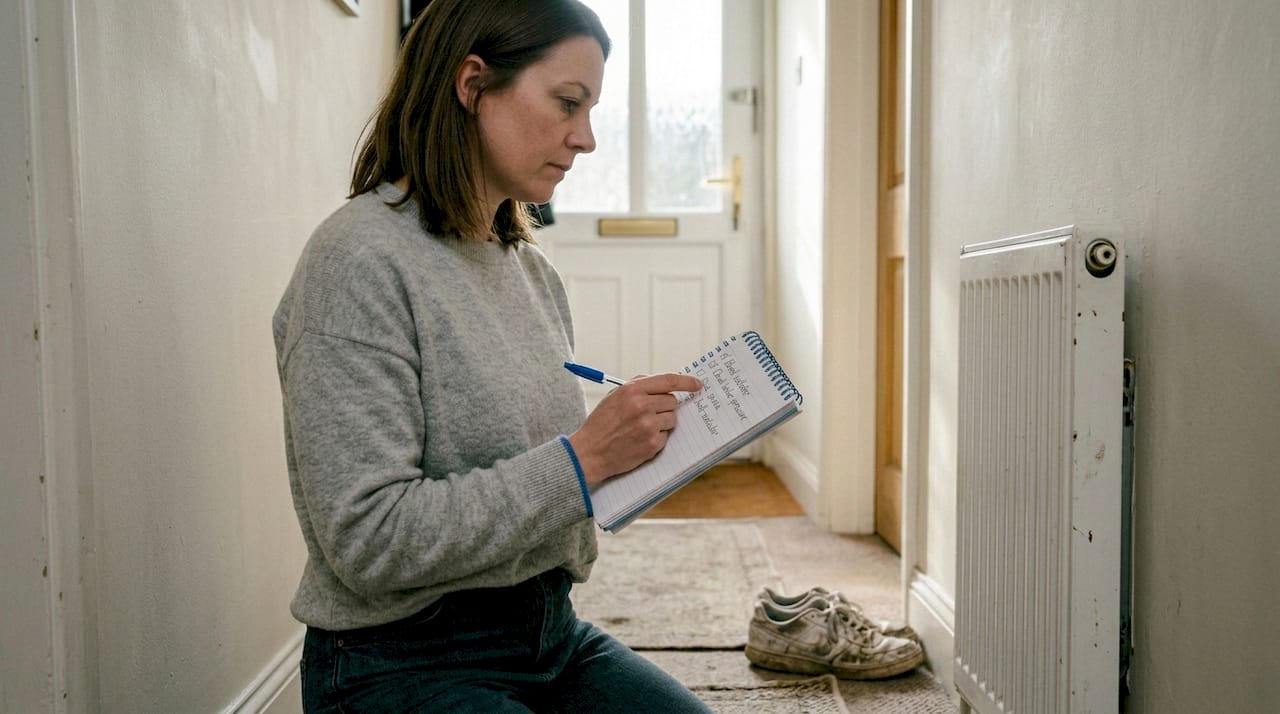
It's important to understand the distinction between what you can do yourself and what must only be handled by a qualified professional. Homeowners can bleed radiators, check the boiler pressure, and visually inspect for obvious leaks. However, anything involving the gas supply, internal boiler components, or flue must be handled by a Gas Safe registered engineer. Attempting gas work without registration is not only dangerous — it's illegal in the UK.
| Task | DIY safe? | Professional required? |
|---|---|---|
| Bleeding radiators | Yes | No |
| Checking boiler pressure | Yes | No |
| Cleaning or replacing burner | No | Yes |
| Inspecting or repairing the flue | No | Yes |
| Annual service and certification | No | Yes |
| Leak detection | Partial | Yes for gas |
After a professional service, you should receive written confirmation of all checks completed, any advisories or faults found, and a Gas Safety Certificate if required. If your engineer simply ticks a form and leaves within 20 minutes without opening the boiler casing, that's a warning sign the service wasn't thorough.
The real benefits: Efficiency, cost savings, and reliability
A well-maintained boiler doesn't just run more safely — it runs more cheaply. When a boiler's components are clean and correctly calibrated, it converts gas to heat with far less waste. A dirty or poorly adjusted burner can reduce efficiency by 10% or more, which translates directly into higher monthly bills.
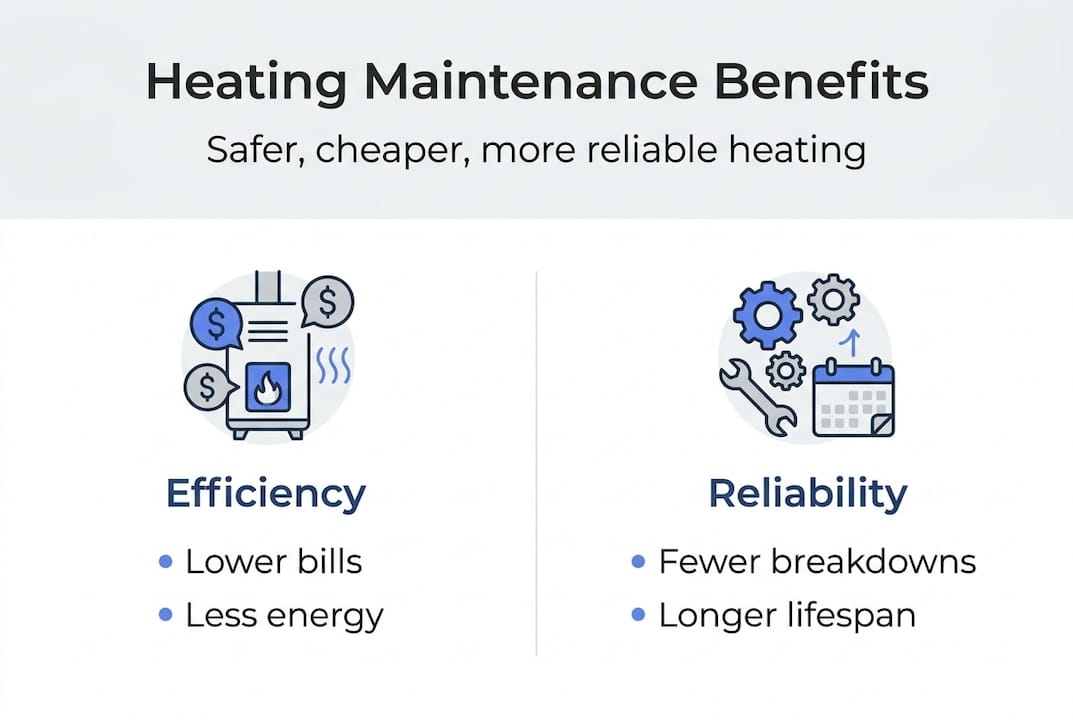
The savings stack up quickly. On a typical UK household gas bill, a 10% efficiency improvement can save £100 to £200 per year depending on your system size and usage. Over the lifetime of a boiler, that's a significant sum. Factor in the avoided cost of emergency repairs, and the financial case for regular servicing becomes overwhelming.
Consider these typical cost comparisons:
| Scenario | Approximate cost |
|---|---|
| Annual boiler service | £80 to £120 |
| Replacing a faulty heat exchanger | £300 to £500 |
| Emergency call-out for a breakdown | £150 to £400 |
| Full boiler replacement (premature) | £1,500 to £3,500 |
Beyond bills, the reliability factor is enormous. Boilers fail most often in winter, precisely when you need them most. A serviced system is far less likely to break down during a cold snap. And when something minor does need attention, a serviced boiler's faults are typically caught early, when they're still cheap to fix.
Pro Tip: Schedule your annual service in late summer or early autumn. Engineers are less busy then, you'll often get quicker appointments, and your system will be verified fit before the cold season begins.
Prevented maintenance also extends boiler lifespan to 10 to 15 years, avoiding the enormous cost of a premature replacement. Compare this to a neglected boiler that may need replacing after just seven or eight years.
Here's what regular maintenance consistently delivers:
- Lower energy bills through improved combustion efficiency
- Fewer emergency call-outs and unplanned repair costs
- Longer appliance life, protecting your original investment
- Predictable maintenance costs, making household budgeting simpler
You can explore more about central heating savings and how heating controls can compound those savings further across your whole system.
Legal, insurance, and warranty implications
This is the section many homeowners skip — until it costs them. The legal framework around heating maintenance in the UK is specific, and the consequences of non-compliance are real.
For landlords, the law is unambiguous. Under the Gas Safety (Installation and Use) Regulations 1998, every rented property must have a valid Gas Safety Certificate, known as a CP12, renewed every 12 months by a Gas Safe registered engineer. Failure to comply can result in significant fines or even criminal prosecution.
For owner-occupiers, there is no legal obligation to obtain a CP12 for your own home. However, the practical implications are nearly as serious:
- Manufacturer warranties almost universally require annual professional servicing to remain valid. Skip a year and your warranty could be void.
- Home insurance policies often include clauses that require reasonable maintenance. A claim following a boiler failure may be declined if you can't demonstrate regular servicing.
- Mortgage lender conditions sometimes specify that heating systems must be maintained and operational, particularly in older properties.
- Proof of servicing is increasingly requested during property sales and valuations as buyers and surveyors assess ongoing maintenance standards.
Understanding why gas leak checks matter and keeping up with the latest plumbing accreditation requirements puts you in a much stronger position when dealing with insurers or warranty providers.
It's worth keeping a dedicated folder, physical or digital, that holds all your service records, engineer certificates, and any correspondence with your boiler manufacturer. This documentation costs nothing to maintain and can be invaluable when you need it most. Non-compliance isn't just a risk for landlords. As a homeowner, leaving your system unserviced is a quiet financial gamble that rarely pays off.
Our perspective: Why the unseen value of maintenance matters even more
At 777 Plumber, we've seen both sides of this. Homeowners who book annual services and rarely have problems, and homeowners who call us in a panic on a freezing January evening because their boiler hasn't been touched in four years.
The heating industry talks a lot about compliance and efficiency, and rightly so. But the real value of regular maintenance is something more personal: peace of mind. Knowing your system has been checked, that your family isn't at risk from a silent carbon monoxide leak, and that you won't face a £500 repair bill before Christmas — that's genuinely priceless.
We also believe that maintenance is the smarter financial strategy. Emergency repairs are reactive and expensive. Planned servicing is proactive and affordable. If you follow our annual maintenance advice, you'll spend less over time, full stop. Start recording every service date and keeping all engineer paperwork. That habit alone puts you ahead of the majority of homeowners.
Get help with your heating maintenance
If you've been putting off your annual boiler service, now is the right time to act. A professional check costs a fraction of what a breakdown or premature replacement would set you back, and it protects your home, your family, and your warranty in one visit.

Our in-house team of fully employed, Gas Safe registered engineers works across the UK with no call-out charges and transparent pricing from the start. Whether you're in Hotwells, Eastfield, or anywhere nearby, you can book quickly and reliably through 777 Plumber. We don't use subcontractors, so every visit delivers the same standard of care. Take the guesswork out of heating maintenance and book your service today.
Frequently asked questions
How often should boilers be serviced in the UK?
Boilers should be serviced annually by a Gas Safe registered engineer to ensure safety, efficiency, and compliance with manufacturer warranties.
What happens during a heating maintenance visit?
A Gas Safe engineer inspects, cleans, and tests your boiler and system, checks for faults and safety risks, and issues the relevant certificates if required. The full annual service is far more thorough than a simple visual check.
Is maintenance required for warranties and insurance?
Yes. Most boiler warranties and insurance policies require documented proof of annual professional servicing to remain valid, so keeping service records is essential.
Can homeowners perform boiler maintenance themselves?
Homeowners can carry out basic tasks such as bleeding radiators and checking pressure, but professional Gas Safe servicing is required for legal, safety, and warranty compliance.