
TL;DR:
- Properly programmed heating controls can save UK households around £110 annually.
- Using a combination of thermostats, TRVs, and smart systems optimizes comfort and reduces energy waste.
- Seasonal adjustments and active management of controls significantly improve efficiency and lower bills.
Many UK homeowners still believe that leaving the heating on low all day is the most efficient approach. Experts disagree, pointing out that programmed, targeted heating almost always beats constant low output. The truth is that your heating controls, not your boiler alone, are the biggest lever you have over both comfort and energy bills. In this guide, we'll walk through every type of control available, the settings that actually work for UK homes, and the strategies that separate genuinely efficient households from those still guessing.
Table of Contents
- Understanding heating controls and how they work
- Essential components: A closer look at UK heating controls
- Why heating controls matter: Comfort, efficiency, and savings
- Advanced strategies: Maximising control and avoiding common pitfalls
- Our perspective: What most homeowners miss about heating controls
- Expert installation and help for your heating controls
- Frequently asked questions
Key Takeaways
| Point | Details |
|---|---|
| Efficient comfort | Heating controls let you stay warm while avoiding wasted energy and expense. |
| Tailored savings | Programming settings to match your lifestyle can cut over £110 from annual bills. |
| No one-size-fits-all | Testing and seasonal adjustments offer more benefit than blanket rules. |
| Expert installation matters | Getting professional setup ensures your controls deliver the best results. |
Understanding heating controls and how they work
Heating controls are the devices and systems that tell your boiler when to fire up, how hot to run, and which rooms to warm. Most UK homes have at least a basic timer and a room thermostat, but modern options go much further. Programmers, thermostats, TRVs, and smart thermostats all play a distinct role in managing your heating schedule, target temperatures, and even individual room comfort.
The key principle behind all heating controls is simple: heat only what you need, when you need it. Every minute your boiler runs unnecessarily adds to your bill without adding to your comfort. Controls let you match your heating output to your actual lifestyle, rather than running a fixed schedule that suits nobody perfectly.
Understanding the role of heating engineers is also valuable here, because a qualified professional can assess your home's layout and recommend the right combination of controls for your specific system.
Here is a quick overview of the main types of heating controls available to UK homeowners:
- Programmer or timer: Sets the times your heating and hot water switch on and off each day.
- Room thermostat: Measures air temperature and signals the boiler to stop once the target is reached.
- Thermostatic radiator valves (TRVs): Fitted to individual radiators, these restrict flow when a room reaches its set temperature.
- Smart thermostat: Connects to your Wi-Fi and allows remote control, learning your schedule and adjusting automatically.
- Cylinder thermostat: Controls the temperature of stored hot water in a separate cylinder, preventing overheating and saving energy.
- Weather compensation control: Adjusts boiler output based on outdoor temperature, reducing energy use on milder days.
Each of these devices works best in combination. A programmer without a room thermostat is like a car with an accelerator but no speedometer. You can set it going, but you have no way to regulate the result.
Essential components: A closer look at UK heating controls
Now that you understand the general function of controls, let's break down the core devices and the settings you'll actually encounter in a UK home.
The table below summarises the main control types, their recommended settings, and the benefits each one brings:
| Control type | Recommended setting | Key benefit |
|---|---|---|
| Programmer or timer | Heat on only during occupied hours | Avoids heating empty rooms |
| Room thermostat | 18 to 21°C | Maintains steady comfort without overheating |
| TRVs | Position 3 or 4 (roughly 18 to 21°C) | Room-by-room temperature management |
| Cylinder thermostat | 60°C | Prevents Legionella risk, avoids scalding |
| Boiler flow temperature | 50 to 60°C | Maximises condensing efficiency |
| Smart thermostat | Personalised schedule | Remote control and learning capability |
The optimal settings for these components are well established. A room thermostat set between 18 and 21°C suits most households, while a boiler flow temperature of 50 to 60°C keeps a modern condensing boiler running at peak efficiency. The cylinder thermostat should sit at 60°C to kill bacteria without wasting energy on excessive heat.
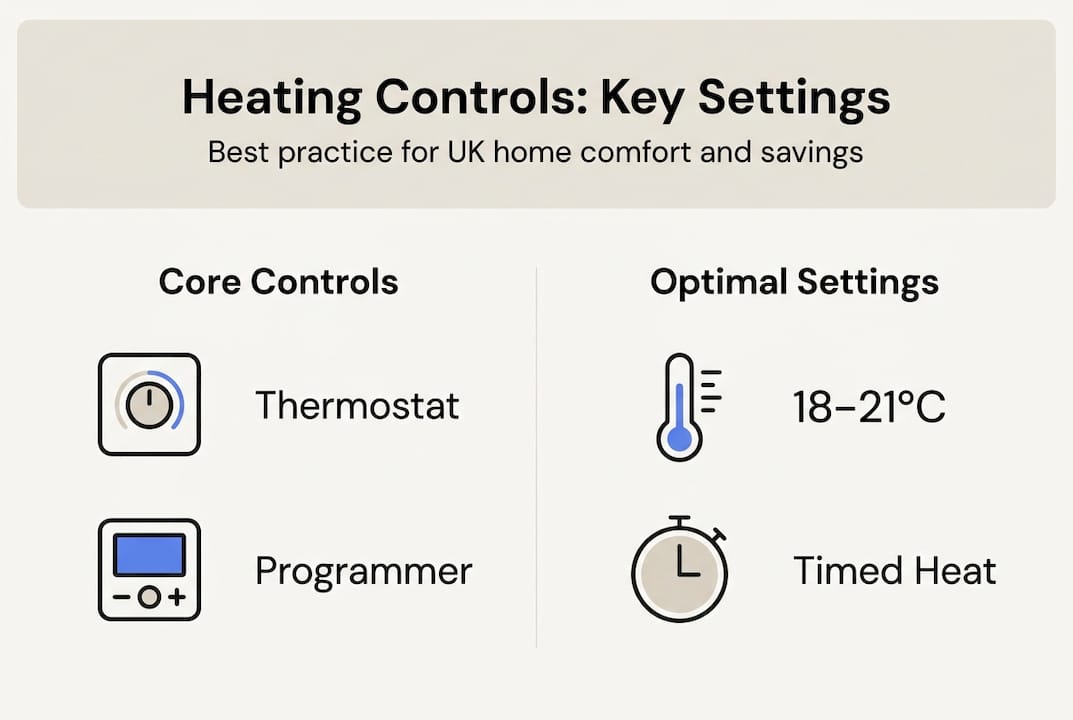
One point that catches many homeowners out is the relationship between TRVs and the main room thermostat. The room where your thermostat is located should never have a TRV fitted. If it does, the TRV can close off that radiator before the thermostat reaches its target, causing the boiler to keep running far longer than necessary.
For further context on how these controls interact with your wider system, it helps to understand the types of plumbing systems found in UK homes, as the right controls depend partly on whether you have a combi boiler, a system boiler with a cylinder, or an older open-vented setup.
Pro Tip: Combining a programmer, a room thermostat, and TRVs on every radiator except the thermostat room gives you the best balance of comfort and efficiency. Each layer of control removes another source of wasted energy.
Why heating controls matter: Comfort, efficiency, and savings
With each control device playing its part, the real question is: why does this matter for your everyday comfort and energy bills?

The numbers are striking. Proper use of controls can save a typical GB household around £110 per year, and simply dropping your thermostat by 1°C can save approximately £90 annually. Heating already accounts for 55% of the average UK energy bill, so even modest improvements in control translate into meaningful savings.
Here are the three biggest reasons to take your heating controls seriously:
- Less wasted energy: Heating an empty house, or keeping rooms warmer than needed, is pure waste. Controls eliminate both problems.
- Greater comfort: A well-programmed system means your home is warm when you wake up and when you return from work, without you having to think about it.
- Lower bills: Consistent, targeted use of your boiler is simply cheaper than running it at a constant low output all day.
Consider two neighbouring homes with identical boilers. The first has only a basic on/off switch and relies on opening windows to cool down. The second has a programmer, a room thermostat set to 20°C, and TRVs throughout. Over a winter, the second home will spend noticeably less on gas while maintaining a more consistent, comfortable temperature in every room.
Regular maintenance also plays a role. When you service your central heating annually, your boiler and controls work together at their best. A poorly maintained boiler can undermine even the most sophisticated controls, because the underlying system is not responding accurately to the signals it receives.
Control is genuinely the most powerful tool available to you. Insulation and new boilers matter, but if your controls are outdated or poorly configured, you are leaving money on the table every single day.
Advanced strategies: Maximising control and avoiding common pitfalls
With the basics and main benefits established, let's move into expert-level strategies and the pitfalls that trip up many UK households.
First, the myths. The idea that leaving your heating on low all day saves money is firmly debunked by major energy suppliers, who consistently recommend programmed use over constant low output. Your home loses heat continuously, so a constantly running boiler is always fighting that loss. A programmed system lets the house cool slightly when empty and reheats it efficiently before you return.
Here are the steps to optimise your boiler flow temperature by season:
- Autumn: Set flow temperature to 60°C as temperatures begin to drop and demand increases.
- Winter: Keep flow temperature at 60°C for maximum heat output and reliability.
- Spring: Reduce to 50°C as outdoor temperatures rise, allowing the boiler to condense more efficiently.
- Summer (heating off): If your boiler runs hot water only, drop flow temperature to around 50°C to maintain efficiency.
As Nesta's research on boiler optimisation highlights, seasonal flow temperature adjustment is one of the most impactful steps a homeowner can take, alongside avoiding TRVs in the thermostat room and considering weather compensation controls that automatically reduce boiler output on milder days.
"Weather compensation and load compensation controls reduce unnecessary boiler cycling and can deliver meaningful reductions in gas consumption without sacrificing comfort." — Nesta
Also, never set TRVs to their lowest position in the room containing your main thermostat. Doing so starves that radiator and confuses the thermostat, leading to longer boiler run times and higher bills. Following central heating best practices and staying aware of UK plumbing regulations ensures your system stays safe and efficient. If you ever suspect a gas issue, always check for gas leaks promptly.
Pro Tip: There is no single perfect setting for every home. Monitor your comfort and your bills over a few weeks after any change, then adjust. Small tweaks often deliver bigger results than one-off overhauls.
Our perspective: What most homeowners miss about heating controls
Most media coverage of heating efficiency focuses on the headline numbers: fit a smart thermostat, save £X per year. That framing is too simple, and it leads homeowners to treat controls as a one-time purchase rather than an ongoing tool.
In our experience, the homes that achieve the best results are those where the occupants actually engage with their controls. They notice when a room feels too warm, they adjust a TRV, they tweak the programme when their routine changes. A smart thermostat installed and then ignored will never outperform a basic programmer that someone actively manages.
The physical placement of your thermostat matters more than most guides admit. A thermostat positioned near a draughty window or in a hallway that heats up quickly will give the boiler inaccurate readings, causing it to cut out too early or run too long. Sometimes solving plumbing problems and improving heating efficiency comes down to something as simple as relocating a sensor.
Our advice: treat your heating controls as a system you refine over time, not a box you tick once.
Expert installation and help for your heating controls
Getting your heating controls right is genuinely worthwhile, but complex systems, older properties, and unfamiliar boiler types can make it difficult to know where to start. Professional advice ensures you get the right combination of controls for your home, fitted safely and configured correctly from day one.

At 777 Plumber, our fully employed, in-house engineers can assess your current setup, recommend upgrades, and carry out installations with no call-out fee and transparent pricing. Whether you need a new smart thermostat, a full controls upgrade, or simply a second opinion, we are ready to help. Our local teams cover areas including Hotwells, Eastfield, and Headley Park. Book online today and take control of your home's comfort and running costs.
Frequently asked questions
What are the main benefits of installing heating controls?
Heating controls boost comfort, reduce wasted energy, and lower bills by giving you precise management over when and where your home is heated. They are the single most accessible upgrade available to most UK homeowners.
How much money can heating controls save each year?
Proper use can save a typical UK household around £110 per year, and reducing your thermostat by just 1°C can save approximately £90 annually on top of that.
What setting should I use for my boiler flow temperature?
Experts recommend 60°C in winter and 50°C in spring and summer to maximise condensing efficiency while maintaining reliable comfort throughout the year.
Is it better to leave heating on low all day, or use a programmer?
Using a programmer is more efficient. Constant low heating is consistently debunked by major energy suppliers, who recommend scheduled, programmed use to avoid unnecessary energy waste.