
TL;DR:
- Choosing the right home heating system involves evaluating efficiency, costs, and existing infrastructure to ensure optimal performance.
- Heat pumps, especially ground source models, offer high efficiency but require suitable land and investment, whereas traditional gas boilers remain cost-effective where gas access exists.
Choosing between the many home heating system types available today is one of the most consequential decisions you will make as a homeowner. Heating accounts for 29% of a typical household's utility bill, so the system you pick shapes your comfort, your annual running costs, and your property's carbon footprint for years to come. Whether you are replacing an ageing boiler, renovating a property, or comparing options for a new build, understanding what each system actually offers, rather than relying on broad generalisations, is where good decisions begin.
Table of Contents
- Key takeaways
- 1. Gas boiler with central heating (wet system)
- 2. Air source heat pumps
- 3. Ground source heat pumps
- 4. Electric storage heaters
- 5. Electric panel heaters and infrared panels
- 6. Ductless mini split systems
- 7. Biomass and wood pellet boilers
- 8. Oil boilers
- 9. Hydrogen-ready boilers
- Comparing efficiency and running costs
- Installation costs and home suitability
- How to choose the right heating system for your home
- My take on choosing a heating system
- Ready to find the right heating system for your home?
- FAQ
Key takeaways
| Point | Details |
|---|---|
| Heating dominates energy bills | Heating accounts for 29% of home utility costs, so system choice has a major financial impact. |
| Heat pumps lead on efficiency | Heat pumps deliver 3 to 5 units of heat per unit of electricity, far outperforming direct electric heating. |
| Upfront cost varies enormously | Installation costs range from a few hundred pounds for electric heaters to over £20,000 for ground source heat pumps. |
| Whole-house approach matters | Combining an efficient heating system with insulation and air sealing can cut heating costs by 30%. |
| Get professional advice early | A qualified heating engineer will identify the right system for your home's size, layout, and existing infrastructure. |
1. Gas boiler with central heating (wet system)
The gas boiler connected to a network of radiators remains the most common home heating system type in the UK. A boiler heats water and circulates it through radiators in every room, with a separate hot water cylinder or a combi unit providing domestic hot water too.
Modern condensing gas boilers are considerably more efficient than their predecessors. They recover heat from flue gases that older models simply vented outside, pushing seasonal efficiencies above 90%. For homes already connected to the gas grid, this system is typically the most cost-effective to run on a day-to-day basis. The main drawback: gas is a fossil fuel, and the UK's pathway toward net zero means long-term reliance on it carries regulatory and cost uncertainty.
Pro Tip: If you have a combi boiler and notice a drop in hot water pressure, common boiler faults are often traced to limescale build-up in the heat exchanger. An annual service catches this early.
2. Air source heat pumps
Air source heat pumps (ASHPs) extract heat from outdoor air and transfer it indoors, even in temperatures as low as minus 15°C. They do not generate heat through combustion. Instead, they move it, which is why heat pumps deliver 3 to 5 units of heat for every one unit of electricity consumed. That ratio is called the coefficient of performance (COP), and it makes ASHPs far more efficient than any electric resistance heater.
ASHPs work best in well-insulated homes and pair well with underfloor heating or larger radiators, because they operate at lower flow temperatures than gas boilers. In the UK, the Boiler Upgrade Scheme offers grants that reduce installation costs significantly, making this one of the most financially attractive renewable options currently available.
3. Ground source heat pumps
Ground source heat pumps (GSHPs) work on the same principle as ASHPs, but they draw heat from the ground via buried pipes called ground loops. Because ground temperatures remain relatively stable year-round at around 10 to 12°C in the UK, GSHPs maintain a consistent COP regardless of weather, often achieving higher seasonal efficiencies than air source models.
The trade-off is installation complexity. You need sufficient garden space for horizontal loops, or access for vertical borehole drilling if land is limited. Installation costs are considerably higher as a result. GSHPs suit rural properties and new builds where the groundwork can be planned from the outset.
4. Electric storage heaters
Storage heaters charge up overnight using cheaper off-peak electricity and release heat gradually throughout the day. They require no boiler, no pipework, and minimal installation work, which makes them a practical choice for flats, listed buildings, or properties where wet central heating is not feasible.
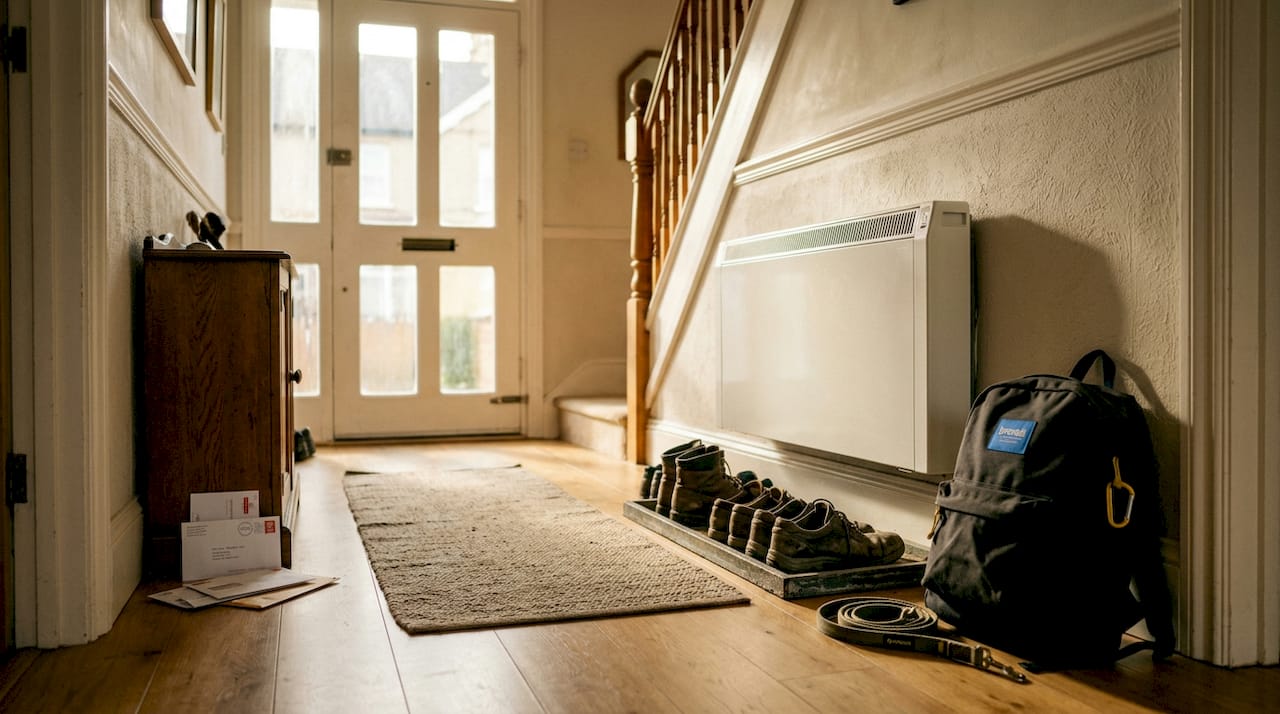
The limitation is control. Traditional storage heaters are difficult to regulate precisely, and if they run out of stored heat by late afternoon, you are left in the cold. Modern high-retention storage heaters are a significant improvement. They retain more heat and release it on demand rather than through passive radiation, giving you far more flexibility.
5. Electric panel heaters and infrared panels
Electric panel heaters and infrared panels are at the simpler end of the heating system types spectrum. Panel heaters warm the air in a room, while infrared panels emit radiant heat that warms objects and people directly rather than heating the air around them.
Both are inexpensive to purchase and simple to install, but running costs are higher than most alternatives because they rely on direct electrical resistance. They work well as secondary or supplementary heating in specific rooms, such as a converted garage, a home office, or a bathroom, rather than as a whole-house solution.
6. Ductless mini split systems
Ductless mini splits are essentially heat pumps without the ductwork. A single outdoor unit connects to one or more indoor air-handling units mounted on walls or ceilings, providing both heating and cooling. Single-zone systems cost between $3,000 and $7,000 to install, while multi-zone systems range from $8,000 to $25,000+ depending on complexity.
For homes without existing ductwork, mini splits outperform central air systems on both efficiency and zoning capability. You only heat the rooms you are actually using, which reduces waste significantly. The zoning benefit is particularly useful in large homes where different occupants have different temperature preferences or schedules.
Pro Tip: When planning a multi-zone installation, complex line routing and branch boxes add both cost and potential performance loss. Map your layout with an engineer before committing to the system design.
7. Biomass and wood pellet boilers
Biomass boilers burn wood pellets, logs, or chips to heat water in the same way a gas boiler does. They are classed as renewable heating because the carbon released during combustion is broadly equivalent to the carbon absorbed by the trees during growth.
Running costs can be competitive with gas, particularly in rural areas where wood fuel is locally sourced and affordable. The drawbacks include the physical size of the boiler unit, the storage space required for fuel, and the need for regular ash removal. Biomass suits detached rural properties with ample space and access to reliable fuel supplies.
8. Oil boilers
Oil boilers operate similarly to gas boilers but burn heating oil stored in an on-site tank. They are the dominant heating system type in rural areas where mains gas is not available. Efficiency ratings on modern condensing oil boilers are comparable to gas models.
The main vulnerability is oil price volatility. Costs can fluctuate sharply, and you need to manage deliveries and maintain adequate tank levels, particularly before winter. Long-term, oil heating faces the same regulatory pressures as gas, with government policy pushing households toward lower-carbon alternatives.
9. Hydrogen-ready boilers
Hydrogen-ready boilers are a relatively recent development. They are designed to run on natural gas now, but can be converted to burn hydrogen with minimal modifications if and when a hydrogen gas network becomes available. Several manufacturers introduced certified hydrogen-ready models in the UK market in 2023 and 2024.
The practical reality in 2026 is that a hydrogen grid for domestic heating remains a future prospect rather than a current option for most homeowners. A hydrogen-ready boiler is worth considering if you want your new installation to have a longer viable lifespan, but it should not be treated as a green solution today.
Comparing efficiency and running costs
Understanding the efficiency differences between home heating system types helps you predict long-term running costs more accurately.
| System type | Typical efficiency or COP | Fuel | Relative running cost |
|---|---|---|---|
| Condensing gas boiler | 90 to 95% | Natural gas | Low to moderate |
| Air source heat pump | COP 3 to 5 | Electricity | Moderate (highly efficient) |
| Ground source heat pump | COP 3.5 to 5.5 | Electricity | Low to moderate |
| Electric storage heater | 100% (resistance) | Electricity (off-peak) | Moderate |
| Electric panel heater | 100% (resistance) | Electricity | High |
| Oil boiler | 90 to 95% | Heating oil | Variable |
| Biomass boiler | 85 to 92% | Wood fuel | Low to moderate |
The 2026 ENERGY STAR Version 6.2 update focuses on real-world performance benchmarks rather than laboratory figures, which is a meaningful shift. It helps homeowners compare heat pump models based on how they actually perform in typical domestic conditions rather than idealised test scenarios.
"Heat pumps are most efficient when set to a constant temperature rather than frequently adjusted. Treat them like a slow cooker, not a microwave." — Consistent with heat pump operation guidance from the U.S. Department of Energy.
Whole-house energy upgrades combining efficient heating equipment, insulation, and air sealing can save around 30% on heating costs. That means the system you choose matters, but so does the building it sits inside.
Installation costs and home suitability
No heating system is universally suitable. Your existing infrastructure, home size, insulation levels, and local climate all determine which types of heating systems will actually work well for you.
Homes with existing radiator pipework and gas connections have the lowest barrier to installing a new gas or hydrogen-ready boiler. Adding a heat pump to the same property requires checking whether the radiators are large enough to work at lower flow temperatures, and upgrading insulation if the building fabric is leaky.
Properties without any ductwork or wet heating systems are strong candidates for ductless mini splits. Adding zones to a multi-zone system reduces the per-zone cost overall, but complex layouts with long pipe runs push labour costs up. Always have a heating engineer assess your home's layout before finalising a multi-zone design.
Modern heating controls are worth factoring in at the installation stage. Smart thermostats, weather compensation controls, and zone controllers can improve the performance of almost every system type and are far cheaper to add during installation than retrofit later.
Pro Tip: Professional installation is not just about compliance. DIY HVAC work risks include compressor damage from moisture in refrigerant lines, which voids warranties and creates costly failures.
How to choose the right heating system for your home
Matching system type to your specific situation is the practical heart of any guide to home heating systems. Here is a straightforward framework:
- No gas connection: Consider an air source heat pump as your primary system, supported by solar panels if your roof orientation allows. Oil or biomass suits rural properties with fuel storage space.
- Existing gas connection, good insulation: A modern condensing boiler or hydrogen-ready boiler is still a cost-effective choice in 2026. A heat pump retrofit is viable if radiator sizes are adequate.
- Poorly insulated home: Address the building fabric first. No heating system, regardless of efficiency rating, performs well in a leaky house.
- Individual rooms or small spaces: Electric panel heaters or infrared panels are practical. Avoid using them as the sole heat source for an entire property.
- Large home with no ductwork: Multi-zone ductless mini splits give you room-level control and strong efficiency, making them one of the best home heating options for this scenario.
- Environmental priority: Ground source heat pumps and biomass boilers offer the lowest carbon output, particularly when powered by renewable electricity or sustainably sourced fuel.
Regular servicing is a non-negotiable part of owning any heating system. It extends equipment life, preserves efficiency, and in the case of gas and oil boilers, is a legal safety requirement for landlords.
My take on choosing a heating system
I have spoken with hundreds of homeowners over the years who approached a heating system change the same way: they picked the option a neighbour recommended or the one a sales rep led with, without stepping back to assess whether it actually suited their home. That is the single most common mistake I see.
A heat pump is a genuinely excellent piece of kit. In a well-insulated home, the running costs are lower and the environmental credentials are real. But in a draughty Victorian terrace with undersized radiators and no budget for upgrades, it will underperform and frustrate you. The system is not wrong. The fit is wrong.
What I have learned is that the best decision nearly always involves looking at the whole picture: the building fabric, the occupancy patterns, the fuel options available locally, and the budget split between upfront and ongoing costs. I have seen homeowners spend £3,000 on insulation improvements before installing a heat pump and end up with a system that outperforms every projection. I have also seen people skip that step and then blame the technology.
The other thing I would say is to take heating maintenance seriously from day one, whatever system you choose. A well-maintained boiler at 93% efficiency beats a neglected heat pump every time, both for cost and reliability.
— Michael
Ready to find the right heating system for your home?
Choosing between home heating system types is much easier when you have a qualified professional assessing your property alongside you rather than making the decision from a brochure alone.

At 777plumber, our fully employed, in-house heating engineers cover boiler installation, heat pump fitting, and full system replacements. We offer transparent pricing with no call-out fees and no fix-no-fee charges. If you are in the Bristol area and need reliable guidance or urgent support, contact our local plumber in Eastfield team on 0117 287 0018. We are available 24 hours a day, seven days a week.
FAQ
What are the main home heating system types in the UK?
The most common types are gas boilers with wet central heating, air source heat pumps, ground source heat pumps, electric storage heaters, oil boilers, biomass boilers, and ductless mini split systems. Each suits different property types and fuel availability.
Which heating system type is the most energy efficient?
Ground source heat pumps typically achieve the highest efficiency, with a COP of 3.5 to 5.5, meaning they deliver up to 5.5 units of heat per unit of electricity consumed. Air source heat pumps follow closely, both far outperforming direct electric resistance heating.
How much does it cost to install a new heating system?
Costs vary widely. A replacement combi boiler typically costs £1,500 to £3,500 installed. An air source heat pump ranges from £7,000 to £15,000 before any grants. Ground source heat pumps can exceed £20,000. Electric heaters sit at the lower end, from a few hundred pounds per unit.
Can I switch from a gas boiler to a heat pump?
Yes, but you may need to upgrade your radiators and improve insulation first so the system operates efficiently at lower flow temperatures. A qualified heating engineer assessment is the recommended starting point before committing.
How often should a heating system be serviced?
Gas and oil boilers should be serviced annually, both for safety and to maintain efficiency. Heat pumps benefit from a yearly check too, covering refrigerant levels, filters, and electrical connections. Regular servicing extends equipment life and keeps warranties valid.