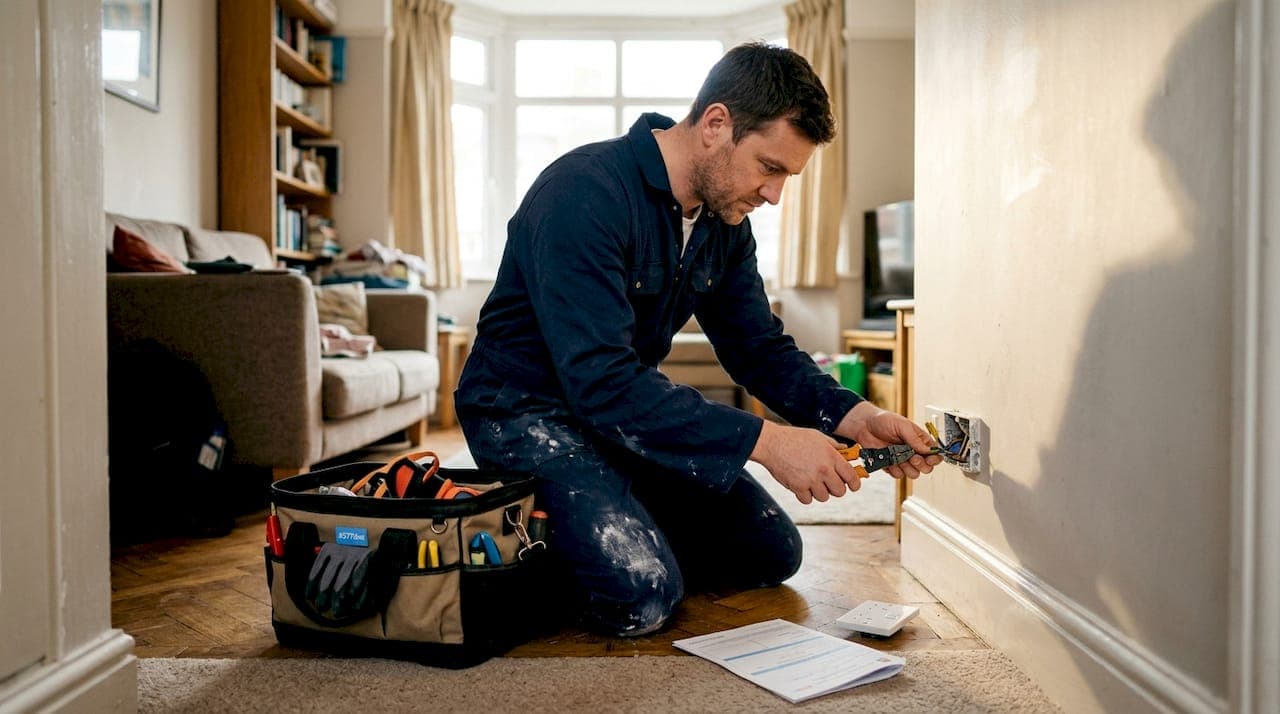
TL;DR:
- Qualified domestic electricians must follow UK safety standards and hold proper accreditation.
- Notifiable electrical work includes installing new circuits, consumer units, and outdoor wiring.
- Hiring an unqualified electrician increases fire risk, insurance issues, and legal penalties.
Hiring an electrician off a local Facebook group or a flyer through your letterbox might seem harmless, but it could be one of the costliest decisions you ever make as a homeowner. Not every person calling themselves an electrician is legally permitted to carry out the same work in your home, and the consequences of getting this wrong range from voided insurance to house fires. This guide cuts through the confusion, explaining what domestic electricians actually do, what the law requires, how to spot genuine credentials, and why accountability matters far more than a cheap quote.
Table of Contents
- What does a domestic electrician do?
- Regulations and certifications: navigating legal standards
- Common electrical problems and how domestic electricians solve them
- Accountability, quality, and why credentials matter
- What most homeowners miss about choosing a domestic electrician
- Need trusted experts for your home?
- Frequently asked questions
Key Takeaways
| Point | Details |
|---|---|
| Certified electricians are essential | Only hire professionals with recognised credentials and active membership in schemes like NICEIC. |
| Know the regulations | Certain home electrical works are legally notifiable, and compliance keeps your property safe and insured. |
| Act quickly on warning signs | Strange noises, outages, or hot outlets require immediate qualified inspection to prevent dangerous faults. |
| Accountability matters | Reliable electricians offer guarantees, insurance, and clear complaints processes for homeowner peace of mind. |
What does a domestic electrician do?
Domestic electricians are specialists in the electrical systems found inside homes and residential properties. Their work is distinct from commercial or industrial electricians, who deal with far more complex, high-voltage systems in offices, factories, and public buildings. A domestic electrician's focus is your living space, and that scope is broader than most homeowners realise.
Day to day, a domestic electrician covers a wide range of tasks:
- Installing and upgrading lighting circuits, including LED systems and smart lighting controls
- Fitting new sockets, switches, and USB outlets
- Upgrading consumer units (commonly called fuse boxes) to modern, safer versions with RCDs (Residual Current Devices)
- Installing new circuits for appliances such as electric showers, ovens, or EV chargers
- Wiring and commissioning smart home systems
- Diagnosing and repairing electrical faults
- Carrying out periodic inspections and issuing formal documentation
That last point is particularly important. Key methodologies for qualified domestic electricians include installation and testing using multimeters and insulation testers, fault diagnosis, periodic inspections, and the issuing of Electrical Installation Condition Reports (EICRs). These reports are the written proof that your home's electrics have been professionally assessed and are safe to use.
Domestic electricians also carry out risk assessments before starting any job and complete certification paperwork upon finishing. This documentation protects you legally and is often required when selling your home or making an insurance claim. Understanding electricians' roles in renovations can also help you plan major projects more effectively, ensuring the right professional is involved at the right stage.
Pro Tip: Always ask if your electrician regularly issues EICRs. If they look blank or dismissive when you mention it, that tells you everything you need to know about their level of qualification.
One distinction worth knowing: a domestic-only installer is trained specifically for residential settings and cannot legally work on commercial premises. A fully qualified electrician, by contrast, holds broader qualifications and can work across all settings. Both can be excellent for home work, provided they hold the right certifications.
Regulations and certifications: navigating legal standards
Understanding their daily roles is essential, but legal and safety standards truly set apart qualified domestic electricians.
All electrical work in UK homes must comply with BS 7671, the national Wiring Regulations standard. On top of that, Part P of the Building Regulations governs which types of electrical work must be formally notified to your local building control authority. NICEIC-registered electricians can self-certify notifiable work, meaning they notify the relevant authority on your behalf without you needing to apply separately.
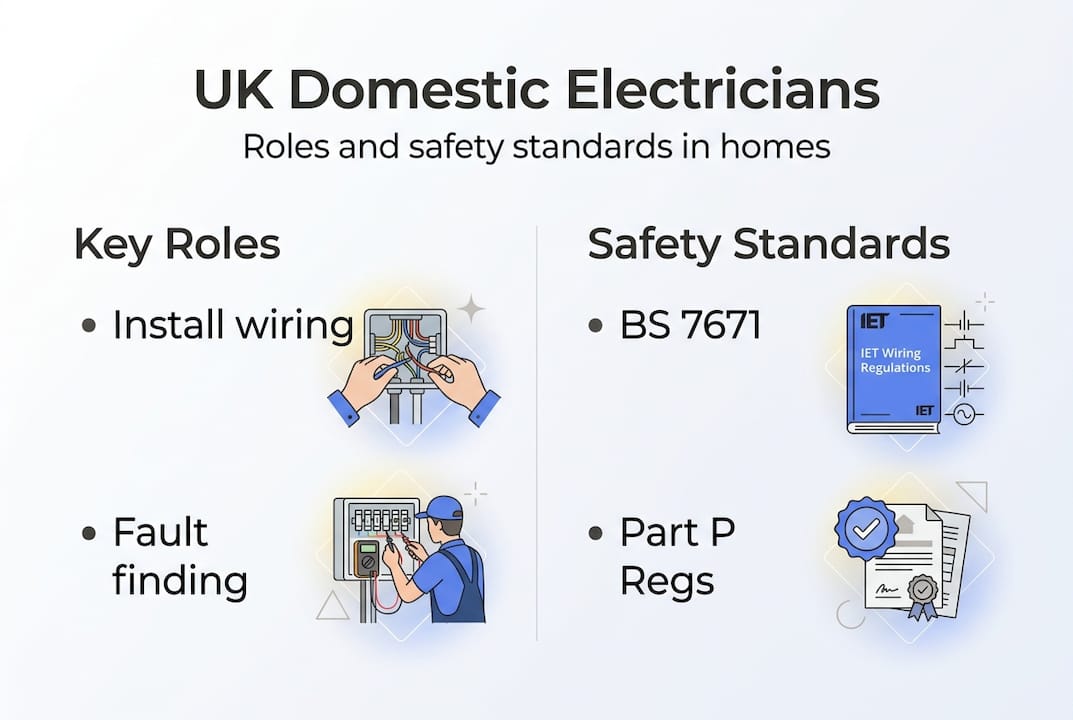
Here is a quick overview of what is and is not notifiable:
| Type of work | Location | Notifiable? |
|---|---|---|
| New circuit installation | Anywhere in the home | Yes |
| Consumer unit replacement | Any | Yes |
| New wiring or sockets | Kitchen | Yes |
| New wiring or sockets | Bathroom | Yes |
| New wiring or sockets | Outdoors/garden | Yes |
| Like-for-like socket replacement | Living room/bedroom | No |
| Replacing a light fitting | Any standard room | No |
To make sure your electrical work is legal and safe, follow these steps:
- Confirm your electrician is registered with a competent person scheme such as NICEIC, NAPIT, or ELECSA.
- Ask whether your specific job is notifiable under Part P.
- Request a completion certificate or building regulations compliance certificate after the work is done.
- Keep all documentation safely filed for future property sales or insurance purposes.
- Check the work on the relevant scheme's online register to confirm it has been properly notified.
Homeowners who use unregistered electricians for notifiable work may face enforcement action from their local council, difficulty selling their property, and invalidated home insurance policies. If you suspect poor or illegal electrical work has been carried out, you can report it to your local authority building control department.
For a broader look at how UK regulations for home installations apply across different trades, it is worth familiarising yourself with the general compliance landscape before any major home project.
Common electrical problems and how domestic electricians solve them
With compliance foundations in place, it is vital to understand the real-life electrical faults and emergencies domestic electricians are called to solve.
Electrical faults in homes are more common than many people think, and some are genuinely dangerous. Common faults include overloaded circuits, loose connections, missing or faulty RCDs, and earth faults, all of which can cause tripping, buzzing sounds, or outlets that feel warm to the touch.
Here is a practical comparison to help you identify what you might be dealing with:
| Symptom | Likely electrical problem | Who to call |
|---|---|---|
| Circuit breaker trips repeatedly | Overloaded circuit or short circuit | Qualified domestic electrician |
| Buzzing from sockets or switches | Loose connection or arcing | Qualified domestic electrician |
| Warm or discoloured outlet | Overheating wiring or poor connection | Qualified domestic electrician immediately |
| Lights flickering in one room | Loose bulb, fitting, or circuit fault | Qualified domestic electrician |
| No power to part of the house | Tripped breaker or blown fuse | Check consumer unit first, then call if unresolved |
Signs you should never ignore at home:
- A burning smell from any socket, switch, or appliance outlet
- Scorch marks around plug sockets or light switches
- Sparks when plugging in devices
- Persistent tripping of the same circuit breaker
- Sockets or switches that feel warm without heavy use
Pro Tip: Light buzzing from a socket or a circuit breaker that trips more than once a week are not minor annoyances. They are warning signs. Contact a qualified electrician immediately rather than waiting to see if the problem resolves itself.
Older properties bring additional complexity. Homes built before the 1970s may still have rubber-insulated wiring, which becomes brittle and dangerous over time. Modern additions such as home safety advice applies broadly, but for electrics specifically, EV charger installations and smart home systems require electricians who are up to date with the latest equipment and regulations. If you are also solving common home problems across multiple systems, it pays to use a provider who handles both plumbing and electrical work under one accountable roof.
Accountability, quality, and why credentials matter
Knowing what problems can occur, let us address why hiring a qualified and accountable domestic electrician protects your family and property.
Credentials are not just paperwork. They represent ongoing assessment, insurance, and a formal complaints process that protects you if something goes wrong. NICEIC certification ensures annual assessments, insurance coverage, warranties, and access to a structured complaints process. This is what separates a genuine professional from an unqualified tradesperson who may seem cheaper upfront but leaves you exposed.
The NICEIC Platinum Promise, for example, provides a five-year guarantee on registered work. That kind of accountability simply does not exist with unregistered electricians.
13% of home fires in the UK are caused by poor or unqualified electrical work. That statistic is not abstract. It represents real families whose homes were damaged or destroyed because someone cut corners on credentials.
There is also an important distinction between a domestic-only installer and a fully qualified electrician. Domestic-only installers complete shorter training programmes and are limited to residential settings, while fully qualified electricians hold an NVQ Level 3 plus AM2 assessment and can work commercially. For most homeowners, a well-assessed domestic installer is perfectly adequate, but knowing the difference helps you ask the right questions.
Steps to verify your electrician's credentials:
- Search their name or company on the NICEIC, NAPIT, or ELECSA online registers.
- Ask to see their current ID card, which should show their scheme membership and expiry date.
- Request proof of public liability insurance.
- Ask when they last had their annual assessment.
- Confirm they will issue the correct certification upon completion.
With a certified electrician, if work falls short of standard, you have a clear route to redress through their registration body. With an unregistered tradesperson, your only option is civil action, which is costly, time-consuming, and often unsuccessful.
Understanding the value of accreditation across home services trades makes it clear why this principle applies equally to electricians and plumbers alike.
What most homeowners miss about choosing a domestic electrician
Most checklists tell you to check for NICEIC registration and move on. That is a good start, but it is not the whole story.
Here is what we have learnt from years of working in home services: registration alone does not guarantee that an electrician is current. The technology inside homes has shifted dramatically in recent years. EV chargers, solar panel systems, battery storage, and smart home integrations are now mainstream requests, and not every registered electrician has kept pace. Asking for proof of recent CPD (Continuing Professional Development) is not being awkward. It is being sensible.
EICR failure rates in older and rented properties are alarmingly high, which tells us that reactive checks are not enough. Proactive inspections, before problems become emergencies, are where real peace of mind comes from. Many homeowners only discover their wiring is dangerously outdated when they try to sell their property and a surveyor flags it.
Pro Tip: Before any job begins, ask your electrician for proof of current insurance and a record of their most recent annual scheme assessment. A confident professional will hand these over without hesitation.
The uncomfortable truth is that the cheapest quote almost never reflects the full cost. Factor in the price of remedial work, potential fines, and insurance complications, and a credible, certified electrician is always the better investment.
Need trusted experts for your home?
Ready to ensure your home's safety and comfort? Finding reliable, accredited tradespeople should not feel like a gamble. At 777 Plumber, our fully employed, in-house team covers both electrical and plumbing needs with transparent pricing and no call-out fees.

Whether you are based near our local trained professionals in Hotwells or need Eastfield home services, we are ready to help with everything from consumer unit upgrades to EV charger installations. Browse our recent work gallery to see the quality we deliver, then request a quote online in minutes. No subcontractors. No surprises.
Frequently asked questions
What qualifications should a domestic electrician hold?
A domestic electrician should carry NICEIC certification or at minimum an NVQ Level 3 plus AM2 assessment to meet UK safety and competency standards. These credentials confirm annual assessments, insurance coverage, and access to a formal complaints process.
Is all electrical work in my home notifiable to building control?
Not all work is notifiable, but new circuits, consumer unit work, and installations in special areas such as kitchens, bathrooms, and outdoors require reporting under Part P of the Building Regulations.
How often should I have my home's electrics inspected?
UK experts recommend getting an EICR periodic inspection at least every 10 years for owner-occupied homes and every 5 years for rental properties.
What are the risks of hiring an unqualified electrician?
Unqualified electrical work can void your home insurance, risk enforcement action from your local council, and is a significant cause of UK home fires. Always verify credentials before any work begins, as 13% of home fires are linked to poor electrical work.