TL;DR:
- Many homeowners overlook the importance of electrical inspections, which reveal hidden hazards and enhance safety. While not legally mandated for owner-occupiers, scheduling regular EICRs helps prevent issues, comply with insurers, and protect property value. Professional inspections involve visual assessments and circuit testing, providing actionable reports that prioritize urgent repairs and prevent costly emergencies.
Most homeowners assume electrical inspections are something landlords worry about, not them. That assumption is understandable, but it could leave your home harbouring hidden dangers you cannot see, smell, or hear. EICR inspections are commonly booked by owner-occupiers for practical reasons including buying or selling, unknown electrical history, and post-renovation safety checks. Whether your wiring is decades old or you have recently had work done, understanding what inspections involve and why they matter is one of the smartest moves a homeowner can make in 2026.
Table of Contents
- Who really needs an electrical inspection?
- What happens during an electrical inspection?
- The real-world impact: safety, compliance and value
- Common questions and mistakes about inspections
- The hidden value of inspections: what most homeowners overlook
- Book your next electrical inspection with trusted local experts
- Frequently asked questions
Key Takeaways
| Point | Details |
|---|---|
| Inspections boost safety | Electrical inspections reveal hidden dangers and reduce fire and accident risks in your home. |
| Not just for landlords | Homeowners benefit from inspections for insurance, peace of mind, and smoother property sales. |
| Legal and practical triggers | Book inspections when required by law, but also after renovations or buying a home. |
| Reports inform action | The EICR explains issues found and what to fix to stay safe and compliant. |
Who really needs an electrical inspection?
Here is where many people get confused. The legal picture is actually quite straightforward once you look at it clearly, but the gap between what is legally required and what is strongly advisable is wider than most people realise.
Landlords and tenants: a clear legal duty
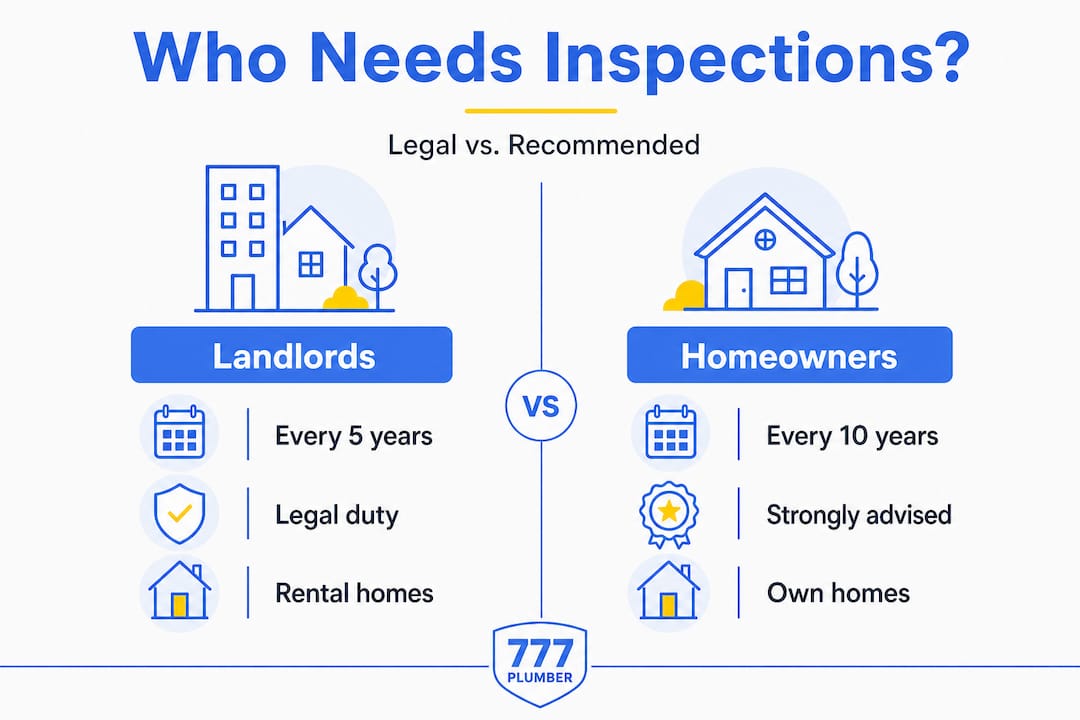
If you rent out a property in England, the rules are firm. Landlords must arrange electrical testing at least every five years, obtain an EICR (Electrical Installation Condition Report), and provide copies to tenants and, if requested, the local council. Failure to comply can result in significant financial penalties. This is not a recommendation. It is the law.
Owner-occupiers: no legal mandate, but strong reasons to act
For homeowners who live in their own property, there is no equivalent legal requirement in most cases. However, owner-occupiers regularly book EICRs for a wide range of practical and safety-driven reasons. Insurers sometimes ask for a valid EICR before they will honour a claim or offer you a competitive premium. Mortgage lenders, particularly on older properties, may expect to see one before they release funds.
| Property type | Legal requirement | Recommended frequency |
|---|---|---|
| Rented (England) | Every 5 years | Every 5 years minimum |
| Owner-occupied | None in most cases | Every 10 years |
| Property purchase | None, but often expected | Before completion |
| Post-major renovation | None | Immediately after works |
| Older property (25+ years) | None | Every 5 to 10 years |
Situations where you should absolutely book one
Beyond the legal side, there are specific moments in a homeowner's life when booking an inspection is not just sensible but essential:
- Buying a home: You cannot see what is behind the walls. A qualified inspection tells you the true condition of the electrical installation before you commit.
- Selling a home: A valid EICR can speed up conveyancing and reduce the risk of a buyer pulling out due to unresolved safety concerns.
- After significant renovation: Any substantial electrical work changes the condition of your installation. Understanding electricians' roles in renovations will help you see why a post-work inspection is always worth arranging.
- Unknown electrical history: If you have lived in a property for a long time without a recent check, or if you moved in without records, you are essentially flying blind.
- After a power surge or electrical incident: These events can damage circuits in ways that are not visible to the naked eye.
Understanding the different domestic electrician roles involved in residential inspections also helps you ask the right questions and choose the right professional.
Pro Tip: If you are planning to sell your property in the next 12 months, booking an EICR now gives you time to address any issues before they become a negotiating problem with buyers.
What happens during an electrical inspection?
Many homeowners put off booking because they are not sure what the process involves. Will it take all day? Will it be disruptive? Will the engineer start pulling wires out of the walls? The reality is far less dramatic, and knowing what to expect makes the whole thing much less daunting.
The step-by-step process
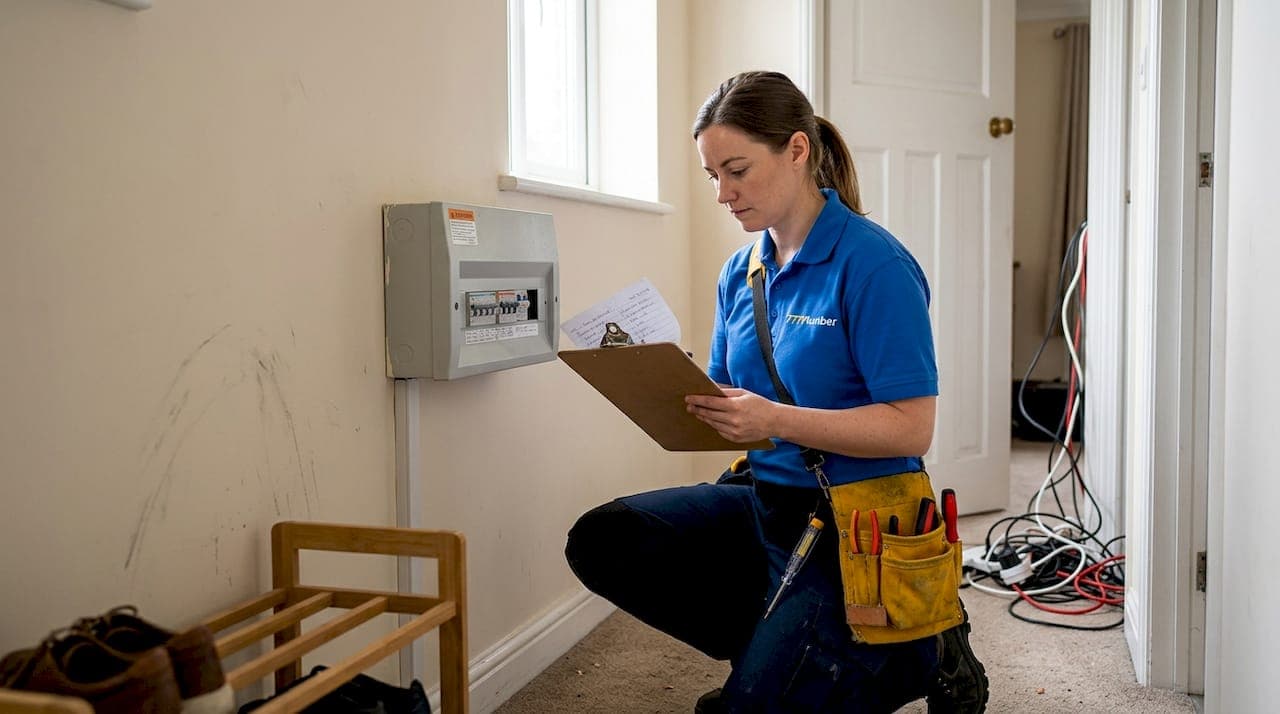
- Visual assessment: The engineer begins by visually examining visible wiring, the consumer unit (commonly called the fuse box), sockets, switches, and light fittings for any obvious signs of damage, deterioration, or non-compliance with current standards.
- Instrument testing: Using specialist test equipment, the engineer checks each circuit in turn, measuring insulation resistance, continuity, and the effectiveness of protective devices such as RCDs (Residual Current Devices). This is where hidden problems come to light.
- Circuit-by-circuit recording: Every circuit is individually logged. Test results are recorded per circuit, and any deviations from acceptable limits are noted with a classification code.
- Defect classification: Faults are not all equal. The EICR uses a standardised coding system to communicate urgency clearly.
- Written report issued: You receive a formal written EICR at the end of the process, outlining what was found, what was tested, and what action is recommended.
Understanding defect codes
| Code | Meaning | Action required |
|---|---|---|
| C1 | Danger present | Immediate action required |
| C2 | Potentially dangerous | Urgent remedial work needed |
| C3 | Improvement recommended | Not dangerous, but worth addressing |
| FI | Further investigation needed | Cannot be assessed without additional work |
A C1 or C2 code means the installation is unsatisfactory. A C3 does not mean the installation has failed, but it should prompt you to consider remedial action. Understanding these codes helps you read your report with confidence rather than alarm.
"The report classifies defects — for example as danger present or potentially dangerous — and recommends remedial actions." This classification system is the key to prioritising what needs to be fixed and when.
Just as you would schedule a central heating safety check to identify boiler or pipe risks before winter, an electrical inspection follows the same preventative logic. Small problems identified early rarely become expensive emergencies.
The real-world impact: safety, compliance and value
It is easy to frame electrical inspections as a bureaucratic requirement. In reality, they deliver measurable, tangible benefits that directly affect your safety, your finances, and your home's value on the open market.
The safety argument is compelling
Electrical faults are a leading cause of house fires in the UK. Older wiring, overloaded circuits, and degraded insulation are invisible hazards that inspections bring into the light. Unlike a leaking pipe or a faulty boiler, electrical faults often give no warning at all until something goes badly wrong.
Key benefits of regular electrical inspections
- Fire risk reduction: Identifying and remediating deteriorating insulation, overloaded circuits, and faulty protective devices directly lowers your risk of an electrical fire.
- Compliance with insurer expectations: Many insurance policies include clauses about the maintenance of electrical systems. Insurance and lender expectations around EICRs are becoming more common, and a lapsed or non-existent inspection record can affect your ability to claim.
- Smoother property transactions: Buyers and their solicitors increasingly request EICR documentation as part of due diligence. Having a current, satisfactory report removes a common source of delay or renegotiation.
- Protection of household occupants: Faulty wiring that is not detected poses risks of electric shock, particularly in rooms with water present such as bathrooms and kitchens.
- Added resale value and buyer confidence: A home with documented, up-to-date safety inspections signals to buyers that it has been well maintained and cared for.
- Early identification of energy waste: Degraded or inefficient circuits can contribute to higher energy bills. An inspection can highlight areas where the installation is not performing as it should.
Booking EICRs for practical and safety reasons is now standard practice among informed homeowners, not just those with a legal obligation. The shift towards proactive safety management, rather than reactive crisis response, is one of the most important changes in how people approach home maintenance.
Think of it in the same way as annual plumbing checks or home safety systems. These are not luxuries. They are fundamental parts of responsible home ownership that protect both people and property.
A note on statistics
Research consistently shows that a significant proportion of homes inspected for the first time in many years are found to have at least one C2 or C3 defect. Properties built before the 1970s, before modern wiring regulations came into force, are statistically far more likely to carry installation defects that present a genuine risk. If your home is more than 25 years old and has never had an inspection, the probability of finding something that warrants attention is high.
Common questions and mistakes about inspections
Even homeowners who understand the value of inspections sometimes make avoidable errors that leave them with a report they do not understand, or worse, no inspection at all.
Debunking persistent myths
"Inspections are only for landlords." This is the most common misconception. As we have established, landlords have a legal duty, but the case for owner-occupiers is equally strong from a safety and financial perspective.
"If the lights work, the electrics are fine." Functioning lights tell you almost nothing about insulation condition, RCD performance, or whether circuits are overloaded. Many of the most serious faults produce no visible symptoms at all.
"It is just a box-ticking exercise." The defect classification system exists precisely because EICRs are not box-ticking. They produce actionable, prioritised findings that directly inform what you need to do and how urgently.
The most common mistakes homeowners make
- Waiting for a problem to appear: By the time an electrical fault makes itself known, it may already have caused damage. Proactive inspection scheduling is always preferable to reactive crisis management.
- Hiring an unqualified electrician: Not every electrician is qualified to carry out EICR inspections. You need someone who is registered with a competent person scheme, such as NICEIC or NAPIT, to issue an official, valid report.
- Ignoring C3 recommendations: A C3 code does not mean the inspection has failed, but homeowners who ignore these recommendations miss an opportunity to address developing problems before they escalate to C2 or C1 level.
- Misreading the inspection interval: The next inspection date is stated in your EICR. Missing it does not just mean an out-of-date document. It means your installation has been operating without assessment for longer than is safe or advisable.
- Not keeping records: Lose your EICR paperwork and you lose your documented proof of compliance. Store your report digitally as well as in hard copy, and keep it with other key property documents.
Just as regular boiler servicing is something most homeowners now accept as essential maintenance, EICRs deserve the same routine place in your home management calendar.
Pro Tip: Always verify your inspector's credentials before booking. Ask which competent person scheme they are registered with and confirm they will issue a formal, written EICR at the end of the visit.
The hidden value of inspections: what most homeowners overlook
Here is the perspective most inspection guides miss entirely. The conversation around EICRs almost always centres on legal compliance or insurance requirements. Those are real and important motivators. But they are not the most compelling reason to book one.
The most valuable thing an electrical inspection does is show you what is already going wrong inside your home before it becomes an emergency. Circuit-level testing records pick up deteriorating insulation, weakening protective devices, and overloaded circuits months or even years before those faults would present themselves as a power outage, a failed appliance, or, at worst, a fire.
We have seen properties where a homeowner has lived comfortably for 15 years, had no electrical problems to speak of, and then an inspection finds three C2 defects in circuits that serve the kitchen and bathroom. These are the highest-risk areas in any home. The homeowner was not being negligent. They simply had no way of knowing, because electrical deterioration is silent and invisible.
The parallel with other overlooked home maintenance tasks is exact. Most homeowners now accept that checking for gas leaks is not something you do only when you smell gas. You do it preventatively because the consequences of waiting are too severe. Electrical faults deserve the same logic.
Homeowners who book inspections proactively, rather than waiting for a legal trigger or an insurance prompt, consistently find that the cost of remediating early-stage faults is a fraction of what it would cost after a fault has developed into a full circuit failure or caused collateral damage. That is not a sales argument. It is just the arithmetic of preventative maintenance.
Book your next electrical inspection with trusted local experts
If reading this has made you realise it is time to book an inspection, or check when your last one was, the next step is straightforward.

At 777 Plumber, our fully employed, in-house engineers carry out residential electrical inspections with the same transparency and accountability we bring to every job. No subcontractors, no hidden call-out fees, and no pressure. We can also bundle your electrical inspection with other essential home maintenance, from boiler servicing to plumbing checks, so you can cover multiple bases in a single visit. Whether you are in Bristol or the surrounding area, our local plumber services team is ready to help you book at a time that suits you. Transparent pricing. Prompt response. Genuine peace of mind.
Frequently asked questions
Is an EICR legally required for homeowners?
No, for most owner-occupied homes in the UK, an EICR is not legally required, but it is strongly recommended, particularly for older properties, ahead of a sale, or after renovation work. Owner-occupiers regularly book EICRs for practical and safety reasons even without a legal obligation.
How often should you book an electrical inspection?
Homeowners are generally advised to book every 10 years, though inspections are also advisable after major renovations or when moving into a property with an unknown electrical history.
What does an EICR cover?
An EICR uses visual checks and instrument testing to assess each electrical circuit, identifies any defects or dangers, and produces a written report with classified recommendations prioritised by urgency.
Do all electricians provide official EICRs?
No. Only qualified professionals registered with a recognised competent person scheme can issue an official EICR. Always verify credentials before booking, as landlords in England and anyone seeking a valid report must use a suitably qualified inspector.